



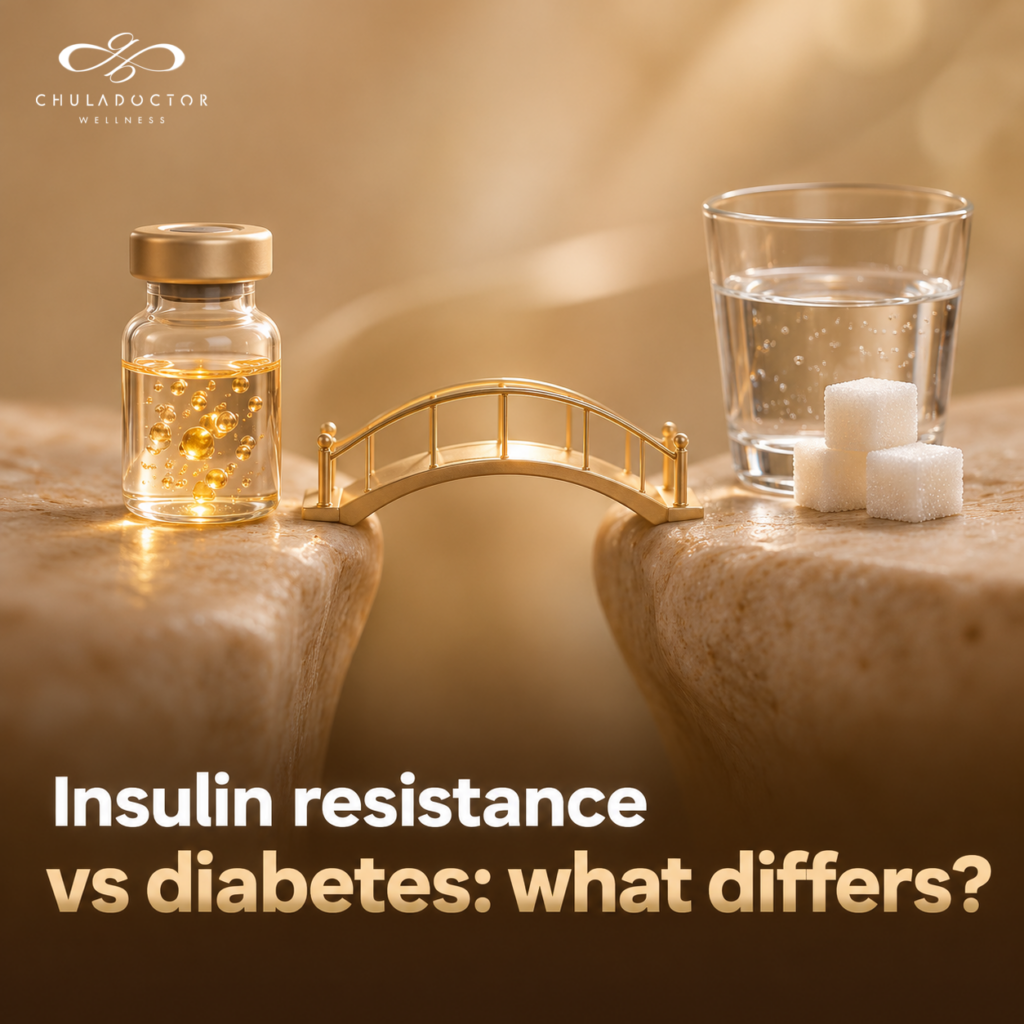
People who learn they have insulin resistance usually ask the same thing first: does that mean I already have diabetes? The short answer is that insulin resistance and diabetes are not the same thing, and you can have insulin resistance without having diabetes. The two are closely linked, though. The American Diabetes Association (ADA) Standards of Care 2026 describe type 2 diabetes as a progressive loss of adequate insulin secretion from the pancreatic beta cells, “frequently on the background of insulin resistance.”
What makes this worrying is how quiet the stage before diabetes tends to be. The US Centers for Disease Control and Prevention (CDC) says 8 in 10 people with prediabetes do not know they have it. This article separates three terms (insulin resistance, prediabetes and diabetes) using criteria that have a named source, then works through the common misunderstandings one by one. If you would like the basics first, start with What is insulin resistance?
How Insulin Resistance, Prediabetes and Diabetes Differ
All three terms sit on the same path of blood sugar control, but each one describes something different. The first says cells respond poorly to insulin. The other two say how high blood glucose has risen. Telling them apart starts with knowing what each term measures.
Insulin resistance: cells respond less to insulin, with no glucose cut-off of its own
Insulin resistance means that liver, muscle and fat cells respond less well to insulin, so the pancreas has to release more insulin to move the same amount of glucose into cells. As long as the pancreas keeps up, blood glucose stays in the normal range and routine results look fine. (The mechanism is covered in Normal blood sugar, high insulin.)
One point people often miss: the ADA’s diagnostic tables use only glucose values and HbA1c. Insulin and HOMA-IR do not appear in them. Insulin resistance therefore has no fixed numeric line the way diabetes does, and doctors assess it from history, waist size, blood lipids, blood pressure and supporting tests together. The ADA also describes type 2 diabetes as relative (not absolute) insulin deficiency together with insulin resistance, which means the pancreas still makes insulin but not enough for the body’s needs.

Prediabetes and diabetes: decided by glucose and HbA1c
The latter two stages are decided by numbers. Under the ADA Standards of Care 2026, prediabetes means any one of the following: fasting plasma glucose (FPG) of 100–125 mg/dL (impaired fasting glucose, IFG), a 2-hour glucose of 140–199 mg/dL during a 75 g oral glucose tolerance test (OGTT; impaired glucose tolerance, IGT), or HbA1c of 5.7–6.4%.
Diabetes begins at an FPG of 126 mg/dL or higher, a 2-hour OGTT value of 200 mg/dL or higher, or an HbA1c of 6.5% or higher. “Fasting” here means no caloric intake for at least 8 hours. Also, without unequivocal symptoms of high glucose, diagnosis requires two abnormal results, either from different tests or from the same test repeated, so a single result is not enough to conclude.
Criteria are not identical everywhere. The ADA notes that the World Health Organization and several other bodies use a lower limit of 110 mg/dL for IFG, while the ADA has used 100 mg/dL since 2003. This article cites only the ADA criteria, which were checked against the source. For Thai guideline thresholds, follow what your treating doctor explains.
Can You Have Insulin Resistance Without Diabetes?
Yes. Two beliefs cause most of the confusion here. The first is that insulin resistance means diabetes right away. The second is that normal glucose means cells respond well to insulin. Each is addressed below.
The pancreas still compensates, so glucose has not risen yet
The first belief is “if you are insulin resistant, you already have diabetes.” In fact these are different stages. A 2009 review by Fonseca in Diabetes Care states that type 2 diabetes “essentially stems from a failure of the β-cell to adequately compensate for insulin resistance.” It cites work by Festa showing that normal glucose tolerance was maintained by a compensatory increase in insulin secretion, that failure to increase secretion led to impaired glucose tolerance, and that a decrease in secretion led to overt diabetes.
Diabetes therefore does not come from insulin resistance alone; the other half is a pancreas that cannot keep up. A person with insulin resistance whose pancreas is still coping can have normal glucose. Insulin resistance by itself does not guarantee diabetes.
The ADA adds that in people who already have type 2 diabetes, insulin resistance “may improve with weight reduction, physical activity, and/or pharmacologic treatment of hyperglycemia but is seldom restored to normal.” That statement applies to people who already have diabetes.
Normal glucose does not mean no insulin resistance
The second belief is “my glucose test was normal, so there is no problem.” That is not always true. While the pancreas is compensating, glucose stays normal even though cells are already resistant. A glucose result can only say the diagnostic threshold has not been reached; it does not say cells are insulin-sensitive.
Other signs can help. The ADA notes that prediabetes is associated with obesity (especially abdominal or visceral obesity), dyslipidemia with high triglycerides and/or low HDL cholesterol, and hypertension. Anyone with a large waist, abnormal blood lipids or high blood pressure should ask a doctor whether insulin and glucose testing is worthwhile, even if the latest FBS was normal.

Does Insulin Resistance Lead to Diabetes, and How Long Does It Take?
The third belief is “once I know I am insulin resistant, diabetes will arrive within a few years.” The sources checked do not give one number that fits everyone. They give average rates in studied groups, and those rates describe people whose glucose had already started to rise, not people with insulin resistance alone, so they should be read with care.
The first example comes from Nichols, cited by Fonseca. Among people whose fasting glucose was 100–109 mg/dL, 8.1% developed diabetes over an average of 29 months (about 1.34% per year), and among those at 110–125 mg/dL, 24.3% did (about 5.56% per year). The second comes from the ADA, which cites a systematic review of 44,203 adults followed for a mean of 5.6 years. People with an HbA1c of 5.5–6.0% had a 5-year diabetes incidence of 9–25%, and those with an HbA1c of 6.0–6.5% had a 5-year risk of 25–50%.
These numbers show a trend: the higher the value, the greater the chance of progressing. They do not say who will progress or when. Fonseca also states that the decline in beta-cell function begins as early as 12 years before diagnosis, meaning the process does not happen overnight. The source does not say how many years insulin resistance precedes diabetes, so this article gives no such figure.
Prediabetes Has No Symptoms, but It Can Still Be Turned Around
The fourth belief is “no symptoms, so no need to test.” The CDC says prediabetes usually has no signs and can go on for years without being noticed until more serious health problems appear. About 115 million US adults, more than 2 in 5, have prediabetes, and most do not know. Having no symptoms is therefore no proof that glucose is still normal.
The good news is that the direction can change. The CDC says proven lifestyle changes help prevent or delay type 2 diabetes, with a goal of modest weight loss of 5–7% of body weight and at least 150 minutes a week of brisk activity. The key evidence is the Diabetes Prevention Program (DPP). The NIDDK reports that the lifestyle group (aiming for 7% weight loss and 150 minutes of exercise a week) lowered the chance of developing type 2 diabetes by 58% compared with placebo after about 3 years, while metformin lowered it by 31%. At 15 years of follow-up, diabetes was still delayed by 27% and 18% respectively.
The accurate wording is “prevent or delay,” not “cure,” because the sources do not promise that values return to normal permanently. For personal assessment by a doctor, the DM Center / ENSYNE at Chula Doctor Wellness is a chronic-disease recovery programme with doctor consultation. To check related values such as HOMA-IR, the Heart Disease Marker programme tests 9 markers, including HOMA-IR. For what the condition can lead to, read Is insulin resistance dangerous?
Summary
Insulin resistance and diabetes are not the same disease. Insulin resistance means cells respond less to insulin and has no glucose threshold of its own, whereas diabetes is diagnosed from glucose and HbA1c using set criteria; without unequivocal symptoms of high glucose, two abnormal results are needed to confirm it. Prediabetes sits between them, and a person can be insulin resistant without diabetes as long as the pancreas keeps compensating.
Still, prediabetes usually has no symptoms and the risk rises with the glucose level, so periodic testing and lifestyle changes at this stage can affect the direction things take. In the Diabetes Prevention Program, these changes were linked to preventing or delaying type 2 diabetes. Results vary from person to person; consult a doctor for advice that fits your own health.